Recycling and Sustainability at Removal Companies Removals
 Removal Companies Removals is committed to making every move as sustainable as possible. As a leading removals company serving boroughs across the region, our environmental policy combines practical reuse, targeted recycling and low-carbon logistics. We set a clear, measurable ambition: to recycle or repurpose 85% of all items that pass through our operations by 2030, while steadily reducing our operational emissions year-on-year.
We work with local authorities and follow each borough???s approach to waste separation???typically separation of paper and card, plastic and metal, glass, and food waste at the kerbside???so our teams are trained to respect local recycling streams. Our house removals and commercial removals crews carry colour-coded sorting kits and guidance to make sure items are separated correctly, reducing contamination and improving recycling outcomes.
![In the foreground, a smiling man dressed in a green polo shirt stands with arms crossed in front of a residential house, likely involved in house removals or relocation services. Behind him, two other individuals are actively loading or unloading cardboard boxes from a large removals van parked on the driveway, which is situated adjacent to the house's entrance. The boxes vary in size and are marked with labels, indicating they contain household belongings such as books, kitchenware, or personal items. The house features a light-colored, textured exterior with a sloped roof, a prominent arched front door, and a small garden area with grass and a few plants. One person, dressed in a red jacket, is visible in the yard, carrying a box towards or away from the house, while the child in a blue shirt is stacking boxes inside the van. The scene is set during daylight with clear skies, illustrating a professional and well-organized residential move, aligning with services offered by removal companies focused on sustainable practices in the UK, such as those found in towns near [POSTCODE] or [TOWN].](/pub/_photos/removals/f1254879864.jpg) As a customer-focused removal firm, we prioritise reuse where possible. Items in good condition are assessed on-site and redirected into reuse routes rather than landfill. We partner with community reuse centres and registered charities to ensure furniture, appliances and usable household goods are given a second life, helping both local people and the planet.
As a customer-focused removal firm, we prioritise reuse where possible. Items in good condition are assessed on-site and redirected into reuse routes rather than landfill. We partner with community reuse centres and registered charities to ensure furniture, appliances and usable household goods are given a second life, helping both local people and the planet.
- Donation partnerships with local charities for furniture and clothing
- Materials segregation for cardboard, textiles, metals and WEEE
- Safe disposal routes for hazardous household items in line with council guidance
Our local transfer stations are central to how we handle recovered materials. Rather than transporting mixed loads long distances, our teams deliver sorted items to nearby transfer facilities where materials are bulked correctly for recycling or redistribution. This decreases haulage miles and ensures that dry recyclables, bulky waste and salvageable goods are handled by the right specialist processors.
Removal Companies Removals has developed formal links with several municipal transfer stations and third-party consolidation yards to optimise routes and minimise double-handling. Using local transfer stations also allows us to support borough-specific schemes???such as separate glass collections or textile banks???so our operations complement council recycling programs rather than complicate them.
 We maintain a clear chain of custody for items we handle: assessment, sorting, transfer and final outlet (recycle, refurbish, donate). This transparency increases material recovery rates and helps us meet our recycling percentage target. Our teams record outcomes for each job, enabling continuous improvement and targeted training.
Partnerships with charities are a cornerstone of our sustainability approach. We work with national and local organisations???including furniture reuse networks, hospice shops and social enterprises???to redistribute quality items. These collaborations reduce waste, support local causes and lower the carbon footprint associated with producing new goods.
Our charity partnerships are more than drop-offs: we coordinate scheduled charity collections, provide condition reports for large donations and, where needed, offer uplift services to community projects. This logistical support helps charities focus on their mission while ensuring that functional items are repaired, repurposed or resold sustainably.
Removal services are evolving. Alongside reuse and transfer station work, we operate a policy of careful deconstruction and salvage during relocations???removing fittings and fixtures intact so they can be reused in refurbishment projects, preventing unnecessary waste.

Low-Carbon Vans and Fleet Strategy
Our fleet is being modernised to reduce emissions: we deploy electric vans for urban work where practical, and low-emission Euro 6 vehicles for longer routes. Telematics and route-optimisation software cut mileage, while driver training in efficient driving techniques lowers fuel consumption and emissions for every move.We also trial hydrogen-ready and plug-in hybrid platforms in partnership with manufacturers and fleet managers, evaluating life-cycle emissions and operational suitability. These investments form part of our long-term sustainability plan for the removal company and help us align with local low-emission zones and borough-specific environmental targets.
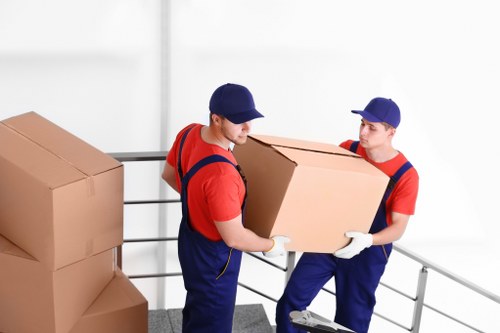
What we expect from clients and partners
To make green moves easier, we ask customers to identify items for donation or recycling when booking, and to follow local recycling guidance for household waste. Together with our dedicated teams, customers help us maximise diversion from landfill and reach the recycling percentage goals we???ve set.In summary, Removal Companies Removals combines practical waste separation aligned with borough approaches, strategic use of transfer stations, strong charity partnerships and a low-carbon fleet to deliver greener removal solutions. Our pledge???an 85% recycle/repurpose target by 2030 backed by ongoing fleet decarbonisation and local collaboration???reflects our commitment to sustainable removals and a circular approach to household and commercial goods.
We continuously measure, report and refine our actions so that every house move, office relocation or single-item pickup becomes an opportunity to reduce impact and support community reuse. By integrating local waste separation practices, using transfer stations intelligently, partnering with charities and investing in low-emission vans, our removal firm aims to lead the sector in responsible, climate-aware relocations.
Removal Companies Removals will keep updating its sustainability plan as technologies and local schemes evolve, ensuring that our removals services remain both effective and environmentally responsible.